Blind Test: Micro Rgb vs Oled Tvs Whats The Difference - Which is Actually Better?
Introduction
Choosing a new TV often comes down to two competing headlines: brilliant blacks and perfect contrast versus sheer brightness and long-term reliability. In recent years two display technologies have risen to the forefront of buyer conversations: Micro RGB (commonly used here to denote microLED implementations that employ discrete RGB micro‑emitters) and OLED (organic light‑emitting diode) panels. This article walks through a practical, blind‑test approach to evaluating these technologies and offers an in‑depth comparison to help readers decide which is actually better for their needs.
Rather than lean on marketing claims, this analysis focuses on measurable performance attributes and real‑world use cases: living rooms with lots of daylight, dedicated home‑cinemas, competitive gaming setups, and commercial displays. It outlines how a fair blind test is performed, breaks down technical differences, presents pros and cons for each option, provides a comparison table for quick reference, and finishes with a buying guide to help match choices to buyer priorities.
How to Run a Fair Blind Test
To determine subjective preference without brand bias, a blind test needs a controlled setup. A meaningful blind test between a Micro RGB (microLED) set and an OLED set should follow these principles:
- Same content sources: Use identical source files (mastered HDR and SDR clips, gaming sequences, and sports footage) played back from the same media player or console.
- Calibration parity: Match picture modes, color temperature, and turn off proprietary image enhancement features so both displays show the same baseline (e.g., set both to a neutral picture mode and standard color space).
- A/B switching: Implement a quick A/B switch controlled by an impartial moderator so viewers don’t know which screen is which. Alternate repeatedly to confirm impressions.
- Ambient conditions: Control the room lighting for scenes meant to test black levels (dim for dark scenes) and raise ambient light for bright scene testing (daylight scenarios).
- Multiple observers and scenarios: Use a small panel of viewers—cinephiles, gamers, and casual viewers—to capture varied priorities. Include close and off‑axis viewing to test uniformity and viewing angles.
- Score and note: Record quantitative scores for brightness, contrast, color accuracy, motion handling, and subjective preference. Take notes on perceived blooming, glow, or banding.
Product Analysis: Micro RGB (microLED)
Micro RGB, in the context of modern displays, refers to microLED panels constructed from tiny, inorganic red, green, and blue LEDs (micro‑emitters) arranged at a micro scale. Because each micro‑emitter produces its own light, microLED is an emissive technology like OLED but uses inorganic materials that tolerate higher currents and temperatures.
In practice this delivers a set of characteristics that distinguish microLED from competing technologies:
- High peak brightness: MicroLED can achieve significantly higher sustained peak brightness without the risk of accelerated degradation seen in organic emitters.
- Excellent contrast: Individual micro‑emitters can be turned off, producing deep blacks and high contrast ratios that approach or equal OLED under controlled conditions.
- Longevity and reliability: Inorganic LEDs are less prone to the gradual luminance loss and burn‑in associated with organic materials.
- Scalability: MicroLED modules can be tiled for very large displays with seamless seams in many commercial implementations.
Real‑world use cases that favor Micro RGB:
- Bright living rooms or family rooms where daylight washes into the viewing area; the extra brightness ensures HDR highlights remain visible.
- Commercial spaces and sports bars where displays run for long periods and require sustained brightness and durability.
- Large‑format, high‑ambient‑light installations where reflectivity and peak luminance matter.
Micro RGB: Pros & Cons
- Pros:
- Extremely high peak brightness and color volume for vivid HDR.
- Excellent durability with significantly reduced risk of burn‑in.
- Minimal blooming compared to local‑dimming LCDs; fine local dimming by per‑pixel emitters.
- Scalable to very large sizes with modular construction.
- Cons:
- Currently very expensive relative to OLED and LED‑LCD options.
- Limited availability and fewer consumer models compared with OLED.
- Calibrated color and uniformity can vary between manufacturers; early implementations may show micro‑uniformity artifacts.
- Potential complex repair/servicing model for tiled or module‑based sets.
Product Analysis: OLED TVs
OLED panels use organic compounds that emit light when driven by current. Every pixel is self‑illuminating, which allows for perfect pixel‑level dimming: when a pixel is off, it produces true black. That capability is central to OLED’s reputation for cinematic contrast and image depth.

Key practical characteristics of OLED in the real world:
- Perfect blacks and infinite contrast: OLED’s per‑pixel control yields exceptional shadow detail and the visual impression of infinite contrast in dark scenes.
- Superior viewing angles: Color and contrast remain consistent even from off‑axis positions, which suits wide seating arrangements.
- Outstanding motion handling: Many OLED sets deliver low response times and pleasing motion clarity for gaming and fast content.
Real‑world use cases that favor OLED:
Find top-rated Electronics products at great prices.
Shop Amazon →- Dedicated home theaters and dark‑room viewing where deep blacks and high contrast are prioritized.
- Avid movie watchers and cinematographers who value shadow detail and color accuracy at relatively lower room brightness.
- Gamers who prefer low input lag, quick pixel response, and smooth motion handling.
OLED: Pros & Cons
- Pros:
- Perfect blacks and outstanding contrast for immersive movie watching.
- Wide viewing angles with minimal color shift off‑axis.
- Excellent motion performance and low latency for gaming.
- Generally more accessible across a wider range of sizes and prices than microLED.
- Cons:
- Moderate peak brightness compared with microLED; HDR highlights can be less pronounced in bright rooms.
- Risk of burn‑in with static content (news tickers, HUDs), though mitigations and warranties have reduced concerns.
- Organic emitter lifetime is finite; very long‑term luminance decline is possible in heavy usage scenarios.
Head‑to‑Head Comparison Table
| Feature | Micro RGB (microLED) | OLED |
|---|---|---|
| Technology | Inorganic RGB micro‑emitters (per‑pixel emitters) | Organic light‑emitting diodes (per‑pixel organic emitters) |
| Peak brightness | Very high; maintains brightness under sustained use | Good, but generally lower than microLED; brightest in short bursts |
| Black levels | Excellent; can approach perfect blacks by switching micro‑emitters off | True blacks (pixels off) — signature OLED strength |
| Contrast | Extremely high; excellent HDR performance in bright rooms | Perceived infinite contrast in dark scenes |
| Color volume | Very high at high brightness levels | Excellent at moderate brightness; can compress at high peaks |
| Viewing angles | Very good; some implementations may show minor shifts | Outstanding; minimal color/contrast shift off‑axis |
| Burn‑in risk | Minimal to none (inorganic LEDs) | Present risk with static elements, though mitigations exist |
| Lifespan | Longer; inorganic emitters are robust | Long, but organics age over many years, potentially reducing peak luminance |
| Energy efficiency | Good, depends on brightness and usage | Efficient in dark scenes; power increases with brightness |
| Size availability | Primarily large formats and modular commercial products; fewer consumer sizes | Wide consumer availability from small to very large sizes |
| Price | High — premium tier at present | Range from affordable to premium; generally more accessible |
| Ideal use cases | Bright rooms, commercial use, large ultra‑bright displays | Home theater, mixed living rooms, gaming, cinematic viewing |
Detailed Practical Considerations
Brightness vs. Black Level: The Tradeoff
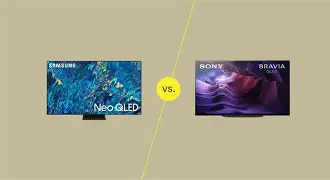
For buyers, the tradeoff between peak brightness and black level often determines perceived image "pop." In bright environments the microLED’s higher peak brightness preserves highlight detail and HDR spectacle. In dark rooms, OLED’s pitch black pixels create an immersive sense of depth that many viewers prefer. The blind test will often show that in dim scenes viewers favor OLED, while in bright scenes microLEDs frequently win on perceived vibrancy.
Burn‑in and Long‑term Reliability
Burn‑in is a major buyer concern. OLED can be susceptible to image retention over years with heavy static UI elements, though manufacturers include pixel shifting, screen savers, and usage recommendations to mitigate risk. MicroLED’s inorganic nature largely eliminates this worry, making it attractive for displays that run static content or operate for very long hours each day.
Gaming and Motion
Both technologies offer gaming advantages: OLED’s fast pixel response yields superb motion clarity and low input lag, while microLED can match or exceed that performance and add higher sustained brightness for HDR gaming. Gamers should also look for features like Variable Refresh Rate (VRR), low latency modes, HDMI 2.1 support, and game‑specific image modes in whichever platform they choose.
Size, Availability, and Serviceability
OLED is widely available from multiple manufacturers across many price points and sizes, with established retail and service channels. MicroLED is still emerging in the consumer space; many implementations are modular and aimed at premium or commercial markets, which can complicate support and raise costs. Buyers who want a traditional retail shopping experience will often find OLED easier to source and service.
Buying Guide: How to Choose
Matching the right display to a buyer’s situation requires prioritizing a few questions. This buying guide walks through the key considerations.
1. What is the room like?
If the living room has large windows or high ambient light, prioritize peak brightness and anti‑reflective coatings — microLED or a high‑brightness LCD variant is beneficial. For dedicated dark rooms, OLED’s perfect blacks will deliver the best cinematic experience.
2. How will the TV be used?
- Movies and TV in a dark room: OLED often provides the most satisfying image.
- Bright rooms, sports, or long commercial use: MicroLED’s higher brightness and durability make it a strong choice.
- Gaming: Both can be excellent; pay attention to refresh rate, VRR, and input lag rather than panel type alone.
- Mixed use: Balance matters—if the room has mixed lighting, gauge whether HDR highlights or black depth is more important to the household.
3. Budget and availability
MicroLED is a premium category with a premium price. If budget is limited, OLED offers most of the cinematic benefits at a substantially lower cost. Consider overall value including warranty terms and manufacturer support.
4. Size and futureproofing
If the buyer wants an ultra‑large, modular display (for example 100" and above) microLED offers options that scale well. For mainstream sizes (55"–77") OLED has more models and price points.
Find top-rated Electronics products at great prices.
View Offers →5. Warranty and service
Check warranty coverage for panel defects and burn‑in protection. Because microLED is newer in the consumer market, review service networks and replacement policies carefully. For OLED, look for policies that cover image retention and clear guidance on usage patterns.
6. Calibration and setup
For the best results, budget for an initial calibration or use professional settings guides. Both technologies benefit from proper setup: disable aggressive dynamic modes, set correct color space (Rec.709 / BT.2020), and enable the correct HDR profile when available.
7. Test before you buy
If possible, conduct an in‑store blind viewing or request a home demonstration. Bring representative content (a favorite movie scene, a game, and a sports clip) and evaluate brightness, blacks, off‑axis performance, and perceived eye comfort.
Final Thoughts and Recommendation
Neither Micro RGB (microLED) nor OLED is objectively "better" across every metric; each technology excels in different environments and use cases. MicroLED offers unmatched sustained brightness, robustness, and suitability for large or high‑ambient‑light installations, while OLED delivers truly black blacks, incredible contrast, and excellent off‑axis consistency for cinematic experiences in darker rooms.
For most consumers, OLED represents the best balance of cinematic picture quality, availability, and price. For those with very bright rooms, commercial needs, or who want the largest, brightest panels with minimal concern for burn‑in over many hours of static content, Micro RGB is the superior—but costlier—option.
Ultimately, a blind test centered on the buyer’s typical content and viewing environment will reveal which panel aligns with personal preference. Viewers who prize punchy HDR highlights in daylight will often prefer microLED; viewers who prioritize deep immersion and shadow detail in controlled lighting will often prefer OLED. Either way, careful calibration, attention to room conditions, and realistic expectations about price and lifecycle will ensure the chosen display delivers the best experience for its intended use.